The Quiet Side Door: How Britain's Scenes Chose Who Gets In
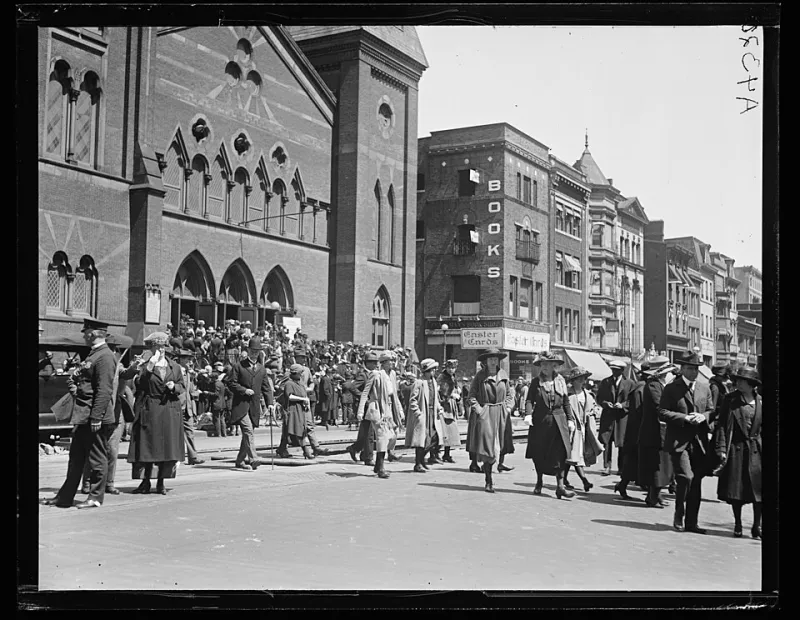
Photo: Harris & Ewing, photographer, Public domain, via Wikimedia Commons
There is a particular kind of Saturday night in Peckham, or under the arches in Digbeth, where nothing about the build-up looks like promotion. No flyer in the feed. No ticket link with a countdown. Just a message in a chat with eleven people in it, a postcode dropped at 6pm, and a mate saying come, it'll be sound. By the time the room fills, everyone inside has effectively been hand-delivered.
That's not a niche quirk anymore. Across the UK, a chunk of the interesting stuff — the low-ceiling gigs, the first-run zines, the clothes swaps, the nights that sell out before a single public post — has slipped out of the open web and into private channels. The group chat has become the guestlist. The mailing list has become a Discord with a vetting step.
From the noticeboard to the feed to the thread
There's a rhythm to this. Through the 2000s, scenes organised on message boards and Myspace bulletins — semi-public, a bit chaotic, searchable if you knew what to type. The 2010s tidied that into blogs and then social feeds, and for a while the promise was total openness: any night, any city, one scroll away.
By 2026 that promise has curdled. Feeds are noisy, throttled and increasingly indistinguishable from advertising. The response, from promoters and small labels in Manchester, Glasgow, Bristol and Leeds, has been to retreat to places where reach is deliberately limited. A Telegram channel with 300 members. A WhatsApp community for a record shop's regulars. A Discord where the gig announcements sit next to a channel about soldering. The point isn't secrecy for its own sake. It's signal.
What a closed room actually changes
When the audience is pre-filtered, the texture of a night shifts. Bookers take stranger risks — a two-hour ambient set at 11pm, a hardcore band on a Tuesday — because they aren't trying to convert a cold crowd. Small labels release records to people who already trust them, which means fewer wasted pressings and, oddly, more adventurous artwork.
Hype works differently too. Public buzz is loud and diffuse; private buzz is quiet and sticky. A night that never trends can sell out three weeks running because the right forty people told another forty. The currency becomes vouching rather than visibility. You don't get in by finding the link. You get in because someone put your name forward.
The cost of the side door
None of this is neutral. A scene that runs on trust also runs on cliques, and Britain has a long history of cool rooms that quietly excluded anyone without the right accent, postcode or friend group. Private infrastructure doesn't remove that bias — it can harden it.
There's a practical squeeze as well. Newcomers, people who've just moved to a city, and anyone outside the core friendship networks are the first to be locked out. The old complaint was that everything was too visible and too commercial. The new one is that the interesting stuff is happening somewhere you can't even search for. Both are true at once.
The voucher economy
What's emerging is less a hidden world than a layered one. At the top, genuinely private: flat-listening sessions, unlisted warehouse nights, closed style swaps. Below that, semi-permeable spaces — shop Discords that anyone can join but few bother to, promoters who'll add you if you ask nicely at the right gig. And underneath, still, the public layer doing the recruiting.
The unglamorous truth is that the side door usually has a bell. Sending a polite message to a label you actually rate, turning up early, buying something, saying hello — it still works. Private scenes aren't sealed. They're just slower to open, and they ask for a small gesture of good faith first.
That's a fairer trade than it sounds. The feed rewarded whoever shouted loudest. The group chat rewards whoever shows up. In 2026, the best culture in Britain isn't the culture you can't find — it's the culture that asks you to introduce yourself before it hands over the address.